 |
|
 |
|
|
|
||
|
|
|
 |
||
|
|
|
Facts about Pluto • Pluto was demoted to a Dwarf Planet in 2006. Diameter: 1,474 miles Distance from Sun (average): 3,674,490,000 miles Atmosphere by Volume: Nitrogen, methane, carbon monoxide with a surface pressure that varies from 0.30 to 1.0 Pa (Earth's atmosphere at sea level is 100,000 Pa or Pascals). Moons: Pluto has 5 moons. Most interesting features in a small telescope: Pluto cannot be observed in any small telescope, however, it is possible to photographic it with a small telescope, but this is beyond the scope of beginners. Click here for an article on imaging Pluto with a small telescope. |
 |
|||||
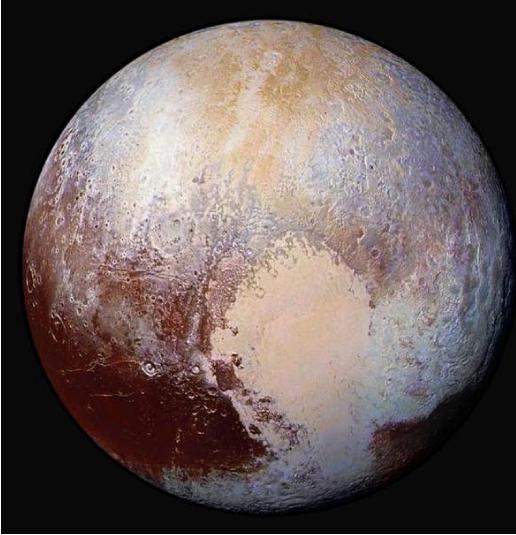
Pluto from the New Horizons spacecraft that flew by in July 2015. |
||||||
|
|
|
|
|
|
|
THE DWARF PLANET PLUTO CLICK HERE for a thorough explanation of why Pluto was demoted from a planet to a Dwarf Planet. However, the short story is that with better telescopes and imaging techniques, astronomers discovered that immediately beyond Neptune, there is a debris field of leftover material from when the solar system formed and that Pluto is just one of the larger pieces in this debris field. When the first asteriod, Ceres, was discovered in 1801, it was also called a planet until more and more asteriods were discovered—then astronomers demoted Ceres to “just” an asteroid. Little was known about Pluto for 85 years because of its distance and small size. It is smaller than many of the moons in our Solar System. It was not until the New Horizons spacecraft flew by Pluto in 2015 that its secrets started to be revealed. Pluto is composed of ices and rocks, accounting for it bright and darker surface coloration as seen in the above picture, and its surface is dynamic, that is, some of its ices flow. Pluto’s orbit is highly inclined to the other Planets. Also, its orbit is not concentric with the other Planets. Instead, for about 20 of the 248 years that it takes to circle the Sun, Pluto’s orbit is closer in than Neptune’s. The last period when Pluto was closer to the Sun than Neptune was from 1979 to 1999. Observing Pluto
The Story of Pluto’s Discovery Clyde Tombaugh the discoverer of Pluto, was born in 1906 and raised on farms in Streator, Illinois and later, Burdett, Kansas. His interest in astronomy came early but was piqued at age 12 when he observed through his uncle’s telescope. After high school, Clyde stayed to help on the Kansas farm. In 1928, he made drawings of Jupiter’s cloud belts and Mars’ surface colorations with a 9-inch diameter telescope mirror that he had ground and polished. Always inquisitive, he sent these drawings off, with questions, to the Lowell Observatory in Flagstaff, Arizona. They were so impressed with the drawings and his interest in astronomy that they offered him a job! So, on January 15, 1929, at the age of 22, Clyde Tombaugh arrived by train in Flagstaff as an astronomer’s assistant. At the time, Lowell Observatory was gearing up to search for a ninth planet, code named “Planet X” by its founder, Percival Lowell. A new and special 13-inch photographic refractor had been ordered and arrived a month after Tombaugh. In April, Clyde started the arduous and systematic search for the planet, photo-graphing the night sky around the ecliptic, the path in the sky subscribed by the Sun over the course of a year but also the path where the other Planets roamed. He took two photographs of the same area of the sky on glass plates a week apart, then compared them in a special-type microscope called a blink comparator. This instrument allowed viewing a superimposed image of the two plates while it alternated the view between them about three times a second. Any “star” that moved from one plate to the other would appear blinking in the “combined” image.Over the course of the year, the Planet X project became Tombaugh’s sole responsibility. On February 18, 1930, Clyde resumed blink-ing plates having a very high density of stars, taken from a section of the Milky Way in the constellation Gemini, near the star Delta Geminorum. The going was slow, but in the early afternoon, Clyde noticed a star blinking on and off, an indication that it had moved. He checked and double checked before calling it to the attentions of the staff astronomers. However, he did not need their verification to know that he had found Lowell’s Planet X. Planet X was named Pluto after soliciting suggestions from the public. The winning entry came from an 11-year-old girl from England. Pluto, the Greek god of the Underworld was an appropriate name for a Planet in the outer reaches of the Solar System. |
 |
||||||||
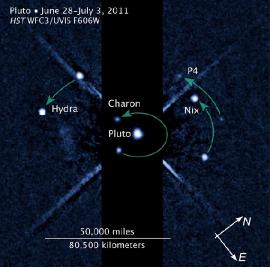
In June/July 2011, a 4th moon of Pluto was discovered. It is designated P4 in this picture. And later, a 5th was discovered. Pluto has been full of surprises! |
|||||||||
 |
|||||||||
The New Horizons spacecraft that flew by Pluto in july of 2015. It does not orbit Pluto, it just flew by and took pictures! |
|||||||||
 |
|||||||||
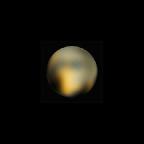
The best "image" of Pluto before the 2015 flyby of the New Horizons spacecraft. This image was a composite from the Hubble Space Telescope that orbits Earth. |
|||||||||
|
|
|
|
|
|
|
|
|
|
What’s Out Tonight? is sponsored by Ken Press, publisher of astronomy books and charts. |
||
|
|
|