Do you think there is life out there?
This is the most frequent question I get asked, especially when I am talking with someone about astronomy, alone.
Because of the almost innumerable stars that are in the Universe, probability alone says that there HAS to be life, like us, somewhere out there. There are at least 200 billion stars in our galaxy and there are at least 100 billion galaxies in the Universe, so that equates to around 200,000,000,000,000,000,000,000 stars in the Universe. And, we know from recent discoveries that planets exist around most stars. Let's say that intelligent life, like our, occurs only on 1 in a trillion planets. Even at this rate, there would be around 200,000,000,000 (200 billion) planets with life at our intelligence level. But remember, galaxies are extremely large and the distance between galaxies is even greater—so it might not be easy for intelligent races to bump into each other.
Almost every space scientist believes that we will find microbial life under the surface of Mars and I wholeheartedly agree, however, at the snail's pace that we are exploring Mars*, we might first detect telltale signs of life-bearing atmospheres on planets orbiting nearby stars (that we see in the night sky) instead of finding life on a planet in our backward. Based on the study of our solar system, many scientists believe that life may be much more plentiful in the Universe than we ever imagined. However, there is a difference between life and intelligent life—how plentiful is “intelligence” life? (Continues here)
___________________________________________________________
Questions about the Sky or Astronomy? • • • Need Telescope Advice? If you have a question about astronomy or
would like advice on buying a telescope or accessories, please email me at ASTROINFO. No charge, no obligation, no hassles.
|
JULY SKY 2011
New Moon: Friday, July 1 — First Quarter: Thursday, July 7
Full Moon: Thursday, July 14 — Last Quarter: Friday, July 22
New Moon: Saturday, July 30
Location of PLANETS when it FIRST GETS DARK:
Venus rises at 5:30 AM just befoe the Sun.
Mars Rises at 3:30 AM in Taurus.
Jupiter rises at 1:30 AM in Aries.
Saturn is lower in the WEST in the constellation Virgo when it first gets dark.
CONSTELLATIONS visible when it FIRST GETS DARK:
Rising in the east: Pegasus
Near the southern horizon: Scorpius
At the top of the sky: Hercules
Setting in the west : Hind of Leo, the Lion
Clock position of the bowl of the Big Dipper when it first gets dark is 9 o'clock.
Meteor Shower: The Southern Aquarids peak around July 29 and feature about 20 meteors an hour.
Want a really nice star chart of the night sky
that also details celestial events?
Visit SkyMaps. |
Great Astronomy Sites to Visit
Astronomy magazine
Sky & Telescope magazine
SkyNews in Canada
Space.com
NASA
Astronomy Picture of the Day
Lunar Picture of the Day
Satellite Tracking
Rainbows & other neat things in the sky
Daily Sunspot Count & other Space Weather (comets plus)
Spacecraft Mission Sites
Images from the Hubble Space Telescope that orbits Earth
Rovers on Mars • Spirit and Opportunity
Phoenix Mars Mission to analyze soil for water
Cassini spacecraft orbiting Saturn
Messenger spacecraft going to Mercury
New Horizons spacecraft going to Pluto
Questions? • • • Need Telescope Advice?
If you have a question about astronomy or
would like advice on buying a telescope or accessories,
please email me at ASTROINFO.
No charge, no obligation, no hassles.
|
AUGUST SKY 2011
New Moon: Sunday, August 28 — First Quarter: Saturday, August 6
Full Moon: Saturday, August 13 — Last Quarter: Sunday, August 21
Location of PLANETS when it FIRST GETS DARK:
Venus is not visible because it is positioned very close to the Sun.
Mars rises in the East at 3 AM in Gemini.
Jupiter rises in the East at 11:30 AM in Aries.
Saturn is very low in the WEST in the constellation Virgo.
CONSTELLATIONS visible when it FIRST GETS DARK:
Rising in the east: Pegasus
Near the southern horizon: Sagittarius
At the top of the sky: Lyra and Hercules
Setting in the west : Virgo
Clock position of the bowl of the Big Dipper when it first gets dark is 8:30 o'clock.
Meteor Shower: The Perseids peak around August 12 and feature about 140 meteors an hour which is over 2 per minute.
|
Astronomy Books & Star Charts
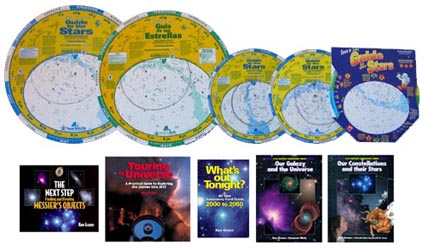
Ken Press publishes a series of popular
star charts and
beginning astronomy books
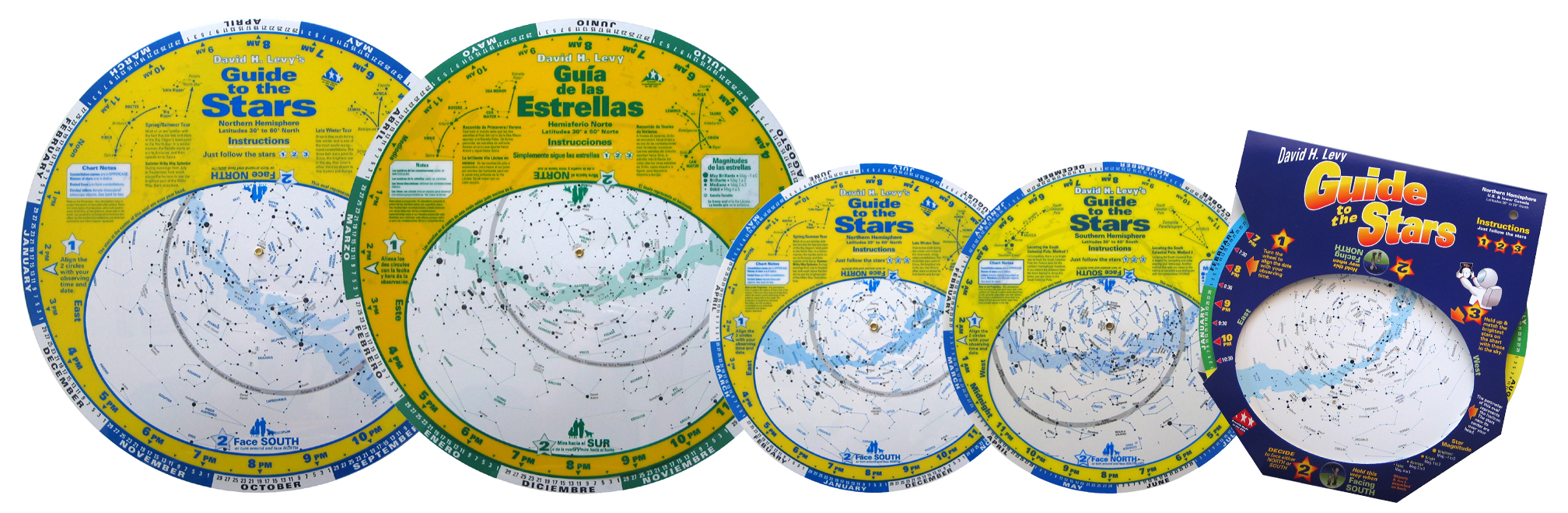
for adults and children. Click here for product info.
Click here for a
PDF brochure.
Contact Ken Press at (520) 743-3200 or email.
|
Bargain Hunters
As of July 2, 2011
Ken Press has a limited number of slightly damaged books and star charts for sale.
To order, call (520) 743-3200. Prices are as follows:
The Next Step (5 copies). Retail $29.95/Slightly skuffed, $15 shipped
Our Galaxy & the Universe (1 copy). Retail $15.95/Cover skuffed, $10 shipped
Touring the Universe (5 copies) . Retail $27.95/Covers skuffed, $13 shipped
Included shipping is by US Mail, book rate, which might take up to 2 weeks. |
Children's Star Chart
This is the chart that appears in the May 2007 issue of
Family Fun Magazine.
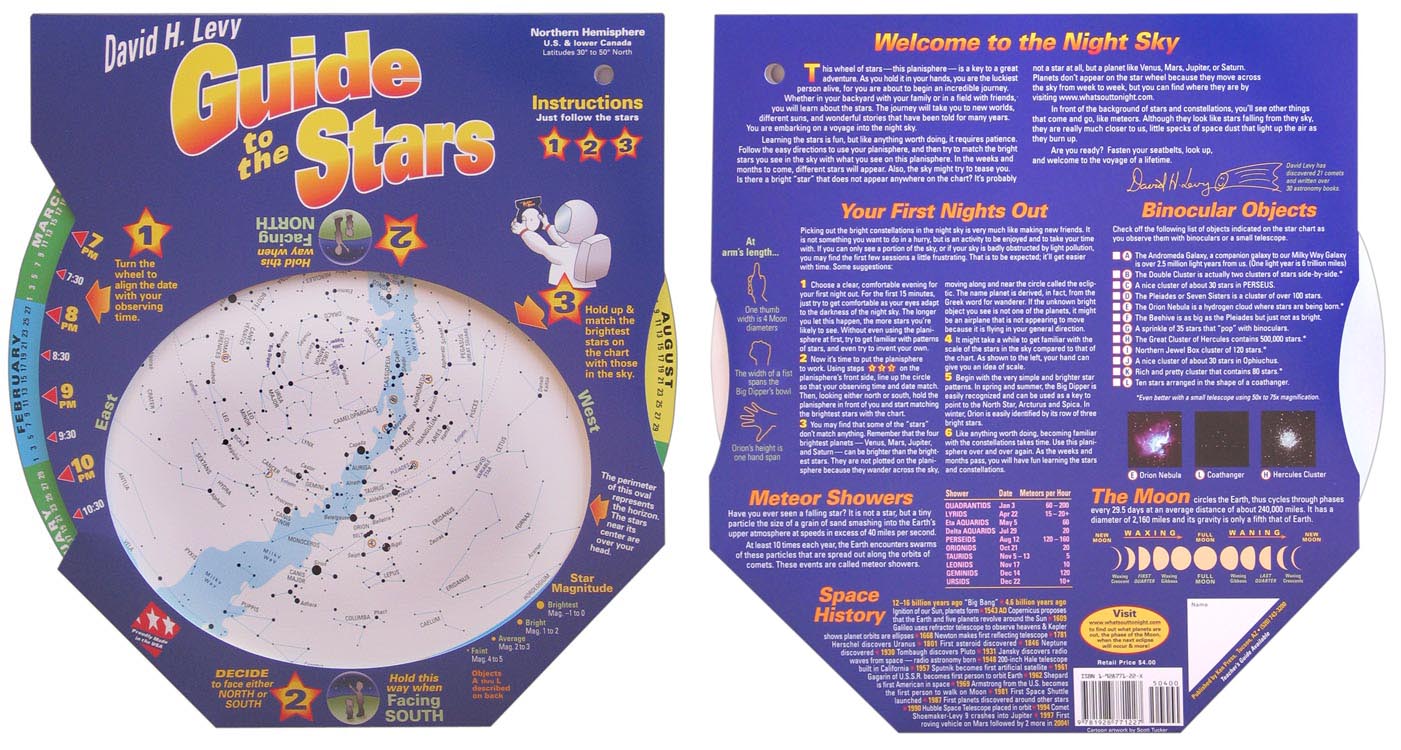
The David H. Levy Guide to the Stars Children's Star chart is an inexpensive way to introduce youngsters to the night sky. This quality star chart is printed in color and made of durable coated card stock paper. The back is loaded with information including Moon facts, Meteor Showers, Space History, Binocular Objects and additional instructions. Price is $4 each (shipping is $4 for 1, 2 or 3 and $7 for 4 or more). To order, Click Here for instructions.
Click on image below to enlarge.

|